
 Written by
Most small-business owners I know have a time problem that looks like a workload problem. The calendar is full, the inbox is full, and the obvious fixes all cost something. Hiring costs money. Automation costs setup time. Writing procedures for someone else costs evenings you don’t have.
There’s one fix that costs nothing: stop doing work that doesn’t need to be done.
It sounds too simple to be useful. But businesses collect tasks the way garages collect boxes. Something made sense once, it became a habit, and nobody ever asked whether it still earns its spot. Before you document, automate or delegate anything, it’s worth finding out which tasks deserve to exist at all. Otherwise you end up carefully training someone to do a job nobody needs.
How much is there to find?
Probably more than you’d guess. Researchers Julian Birkinshaw and Jordan Cohen asked knowledge workers how they spent their time. On average, people said about 41% of it went to tasks that gave them little satisfaction and that someone else could handle competently (Harvard Business Review, 2013).
That number comes with real fine print. It’s self-reported. It comes from people at larger organizations, not small-business owners. And it mixes work that could be dropped with work that could be handed off. So don’t plan your week around 41%. But even a fraction of that is a lot of hours.
The same researchers offered a reason this happens: people hang on to tasks that make them feel busy, and busy feels important. Owners are not immune. Feeling busy just doesn’t pay very well.
The test: one question, three answers
List the recurring things you do in a typical week or month. Reports, check-ins, follow-ups, formatting, “quick looks.” Then ask one question about each:
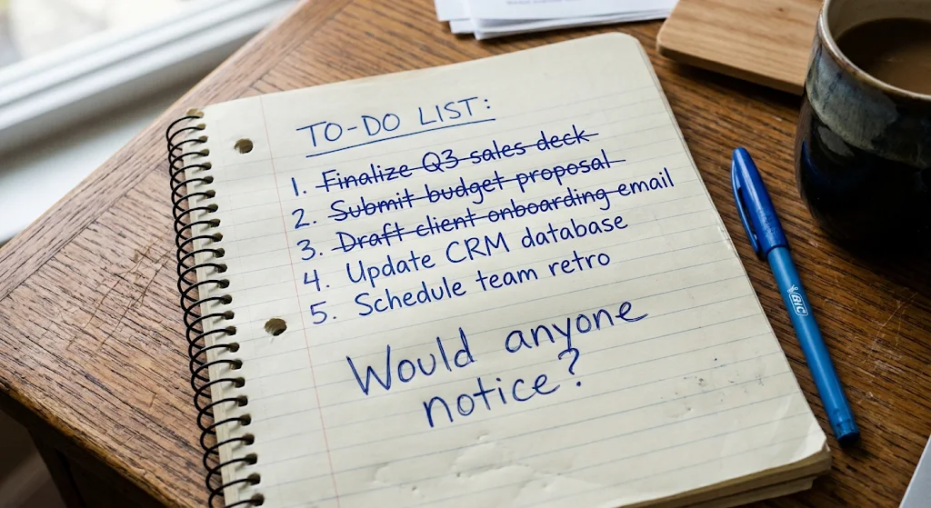
If I stopped doing this for two weeks, who would notice, and what would actually happen?
You’ll get one of three answers:
- “Nobody would notice.” Stop doing it. No announcement needed if no one else touches it.
- “Someone would notice, but nothing bad would happen.” Shrink it (more on that below) or stop it.
- “Something would genuinely break.” Keep it. This is real work. It’s a candidate for a checklist, a tool or a handoff later, not the trash.
When you’re not sure: the quiet two-week trial
Sometimes you honestly don’t know whether anyone relies on a task. That’s where a quiet trial helps. People in IT sometimes call it the scream test: stop doing the thing for two weeks and see who speaks up.
Put a reminder on your calendar for two weeks out. When it comes up, ask:
- Did anyone ask about it?
- Did anything go wrong because it didn’t happen?
- Did I miss it, or did I just feel guilty?
If nobody noticed, you have your answer. If someone did, you’ve learned exactly who needs it and why. That’s useful too, and it often tells you a smaller version would do.
The important exception: never run this test on anything involving taxes, payroll, licenses, insurance, safety or legal deadlines. Those tasks stay quiet right up until they get very loud, usually in an envelope from a government office. The test is for the weekly report nobody reads, not your quarterly filings.
If you have staff: ask before you cut anything they touch. “Who would notice?” includes your team. A quiet trial works best on tasks only you do. And it’s worth asking your team which recurring meetings and updates they’d keep if they had to defend each one. Sometimes everyone has been politely sitting through the same meeting for years.
Shrink what you can’t stop
Some tasks deserve to exist, just not at their current size. Three questions help:
- Could it happen less often? A weekly report could become monthly. A daily check-in could happen twice a week.
- Could it be smaller? Three key numbers instead of twenty. One page instead of ten.
- Could “good enough” do? A lot of owner time goes into polishing internal work nobody studies closely. An internal email rarely needs a second draft.
Shrinking often frees almost as much time as stopping, with less risk.
Watch for habits that feel like work
Some of the biggest time sinks aren’t tasks on a list. They’re habits that show up as dozens of small slices:
- Redoing someone else’s work because it’s faster than explaining what was wrong. (It’s faster once. It’s slower every time after.)
- Checking on things that are going fine.
- Being copied on everything “just in case.”
- Answering messages instantly when nobody needs an answer in the next five minutes.
None of these will jump out at you as one big block of time. Count them for a week and they add up.
Keep a short “not-to-do” list
Stopping a task doesn’t help much if a new one slides into its place. So write down a few things you’ve decided you don’t do anymore, and glance at the list before you say yes to something new. For example:
- I don’t build reports nobody asked for.
- I don’t take projects under my minimum.
- I don’t do same-day turnarounds without a rush fee.
- I don’t attend meetings without an agenda.
It feels a little silly to write down. It works because “no” becomes a policy instead of a fresh decision every time.
What this can and can’t promise
I haven’t found a rigorous study measuring how many hours small-business owners save by cutting tasks. What we have is the self-reported research above, real owners’ accounts, and plain logic: a task you stop takes zero hours. Your results will depend on your business, your customers and how much of your week is truly optional.
But this is the cheapest experiment you can run. It needs no software, no hire and no budget.
Try this Monday
- Write down every recurring task you can think of in ten minutes.
- Pick three that might not need doing.
- Stop the most obvious one today.
- Run a quiet two-week trial on the other two, and set a calendar reminder to check who noticed.
Two weeks from now, you’ll know a little more about which parts of your week are actually holding the business up, and which parts are just habit.